





Introduction:Denim Washing Process
Every pair of perfectly faded, incredibly soft jeans you have ever owned started its life in a very different form: as a stiff, dark, tightly woven fabric known as raw denim. The transformation from that rigid state to a comfortable, character-filled garment is not accidental. It is the result of a carefully engineered industrial process known as denim washing or denim finishing.
From the outside, the washing stage is often misunderstood as a simple aesthetic treatment. But inside our factory at Fabric-Supplier, this process is treated as a science—one that determines fabric stability, shrinkage control, hand feel, environmental impact, and ultimately, brand identity.
Over the past 20 years, I’ve personally overseen the development of hundreds of denim wash recipes, from minimal rinse washes for luxury Japanese brands to highly distressed finishes for European streetwear labels. Each of those finishes started with a clear objective: how do we engineer character while maintaining quality?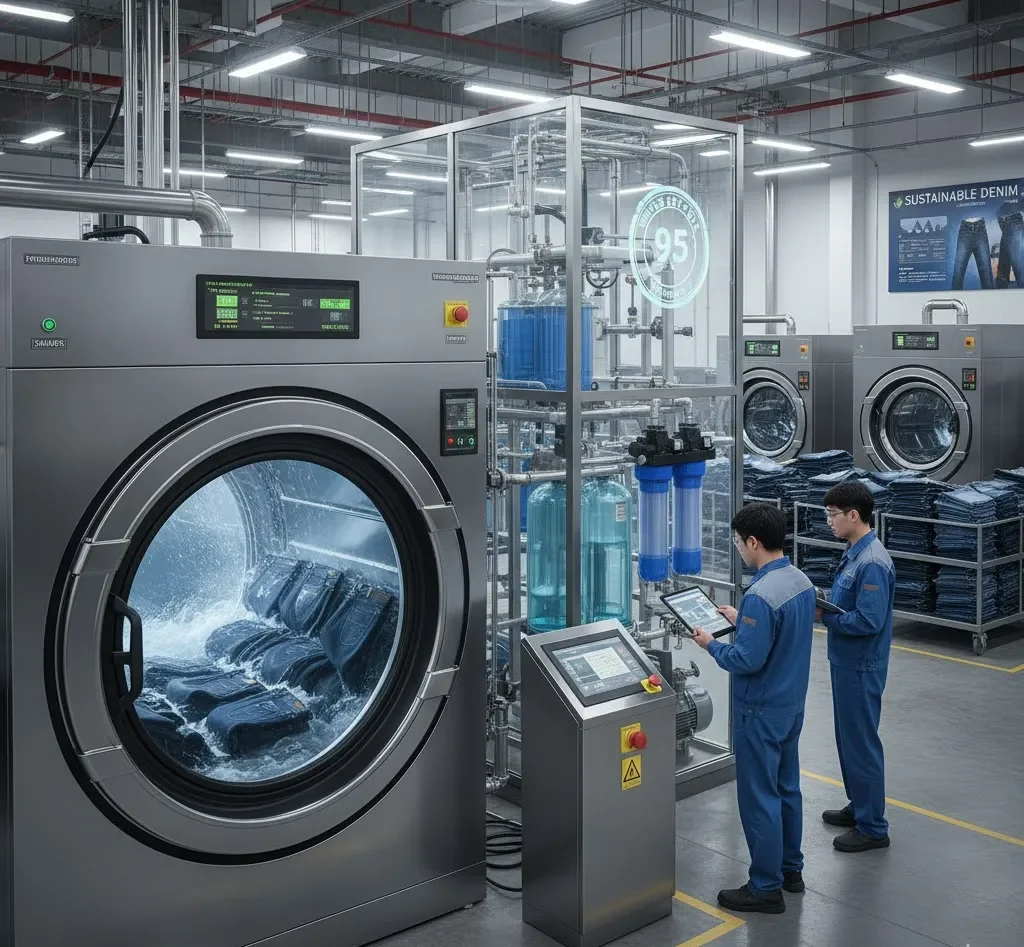 In The Industrial Denim Washing Workshop, Technicians Are Operating Large-Scale Washing Equipment To Process Denim. The Factory Is Equipped With Environmental Protection Devices.
Why this guide matters:
Whether you are a designer choosing your next collection’s signature wash, a sourcing manager trying to control shrinkage, or a brand owner seeking consistency across production batches, understanding the industrial washing process is not optional—it is essential.
📌 Industry Insight (Textile Exchange Denim Impact Report, 2023):
According to global lifecycle assessments, up to 35% of a denim garment’s carbon footprint comes from washing and finishing. This makes the choice of wash not just a design decision, but a sustainability and profitability strategy.
If you are new to denim itself and would like a refresher before diving into the washing stages, we recommend reading our foundational guide: What is Denim Fabric?
Raw Denim vs. Washed Denim: The Core Distinction
To understand the significance of denim washing, we first need to examine what raw denim truly is—and how washed denim changes not only its appearance, but also its physical performance.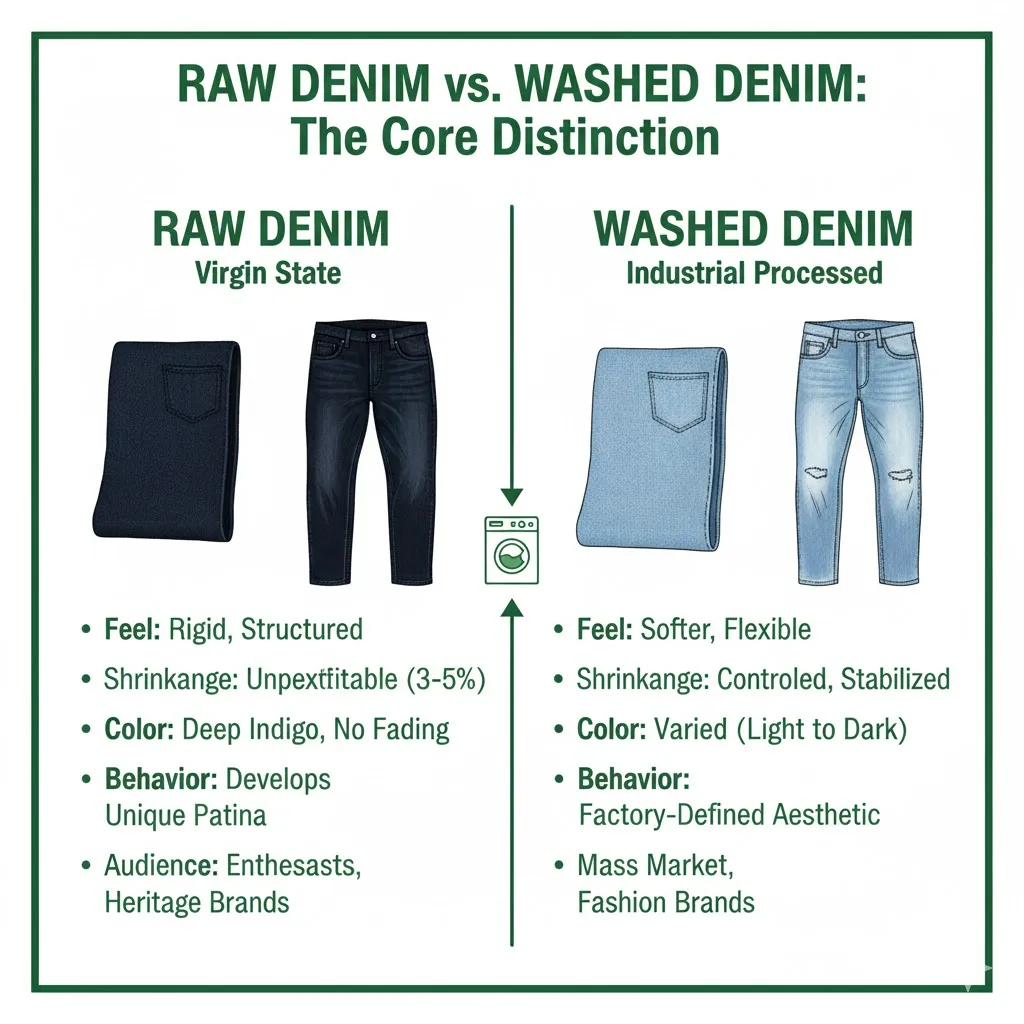 Raw Denim Vs Washed Denim
What is Raw Denim?
Raw denim—also known as dry denim—is fabric in its virgin state after dyeing and weaving. It has not been washed, softened, or artificially distressed. The fabric is stiff due to the starch applied during weaving, and its deep indigo surface is uniform and rich in color.
Feel: Rigid, structured
Shrinkage: Unpredictable if not pre-shrunk
Color: Deep indigo with no fading
Target Audience: Denim enthusiasts and heritage brands
Behavior: Develops unique fading patterns with wear
What is Washed Denim?
Washed denim is fabric or garments that have gone through industrial washing processes to alter softness, texture, color, and dimensional stability. The washing process transforms denim from a raw textile into a wearable product ready for consumers.
Feel: Softer, more flexible
Shrinkage: Controlled and stabilized
Color: Varied from dark rinse to heavily faded
Target Audience: Mass market, fashion-forward brands
Behavior: Aesthetic is factory-defined, not wearer-defined
What Are the Key Differences?
Feature
Raw Denim
Washed Denim
Initial Hand Feel
Very stiff
Soft and wearable
Shrinkage
Can shrink up to 10%
Controlled to under 3%
Color
Solid deep indigo
Ranges from dark to pale with effects
Fade Development
Naturally through wear
Engineered in factory
Audience
Niche denim purists
Mainstream consumers
Why Do We Transform Raw Denim?
Most consumers do not want to wait 6–12 months for denim to break in or soften. From our direct experience working with brands worldwide, denim washing serves three critical functions:
1. Comfort & Wearability
Washing removes surface starch and relaxes fibers, significantly improving comfort from the first wear.
2. Dimensional Stability
Industrial washing allows us to control and lock in shrinkage before the fabric reaches the consumer.
3. Brand DNA Creation
Every wash—whether a subtle rinse or a dramatic destroyed effect—tells a visual story. In many cases, the wash is the identity of the product line.
🎯 In-House Data Snapshot (Fabric-Supplier, 2024):
After conducting 120 test washes on 12 oz raw denim, we observed an average shrinkage of 7.8% pre-wash, which dropped to below 2.5% after controlled washing and sanforization. This confirms that industrial washing is not cosmetic—it is essential for size accuracy and customer satisfaction.
How to Convert Raw Denim into Washed Denim: A Step-by-Step Guide for Mills
Phase 0: The Critical First Step at the Mill – Sanforization (Pre-Shrinking)
Before denim reaches the garment factory for cutting and sewing, it often undergoes a crucial stabilization process at the fabric mill known as sanforization. This process sets the foundation for shrinkage control and is the reason why most mass-market jeans retain their size after purchase.
What is Sanforization in Denim?
Sanforization is a mechanical pre-shrinking treatment performed before the denim is cut and sewn. The fabric passes through a controlled sequence of steaming, stretching, and compression.
Steam relaxes the fibers.
Stretching aligns the yarns.
Compression locks the structure into a stable formation.
This ensures that most of the shrinkage potential is removed before the garment construction begins.
Factory Insight (Helen, Fabric-Supplier):
In our own production lines, we run every batch of denim through a steam-driven sanforizing machine calibrated to maintain residual shrinkage below 2.5%. When we tested unsanforized fabric in a real denim wash cycle, the shrinkage sometimes exceeded 8%, which would have been unacceptable for retail garments. This is why sanforization is considered a non-negotiable quality step in modern denim manufacturing.
Sanforized vs. Unsanforized (Loomstate): The Two Paths
Property
Sanforized Denim
Unsanforized (Loomstate) Denim
Shrinkage
Controlled: <3%
High: 5–10%
Hand Feel
Slightly softened
Very stiff
Target Use
Mass market, premium ready-to-wear
Heritage, raw denim purists
Cost
Higher due to processing
Lower but riskier
Most commercial denim today is sanforized, ensuring dimensional stability and consumer satisfaction. However, loomstate denim is still used by niche, heritage brands who value authenticity and want the end-user to experience natural shrinkage and personalized fades.
Case Observation:
A premium Japanese denim brand we worked with intentionally ordered unsanforized denim for their “shrink-to-fit” collection. They required us to soak each sample garment for 30 minutes in 60°C water before sewing, in order to pre-reveal the natural shrinkage and preserve the integrity of the original fabric grain. This approach is rare, but it highlights how fabric characteristics can be controlled differently depending on brand philosophy.
Industry Reference (Denim Industry Whitepaper – Textile Exchange, 2023):
The global adoption rate of sanforization in denim production now exceeds 92%, driven primarily by the demand for consistent sizing in international retail markets.
Phase 1: The Dry Process — Creating Character Before Water
Before any water touches the fabric, denim garments go through a series of mechanical treatments that manually sculpt the garment’s visual identity. These dry processes determine where fading will appear, how creases will form, and how “broken-in” the jeans will look. At Fabric-Supplier, this stage is considered the artistic foundation of denim finishing.
Factory Perspective (Helen, Fabric-Supplier):
In our workshop, designers often walk in with phrases like authentic vintage, worn-at-the-thigh, or subtle whiskers. Translating these ideas into denim finishes begins with dry processing. I always tell them: before you choose your chemistry, you must define your story through physical texture.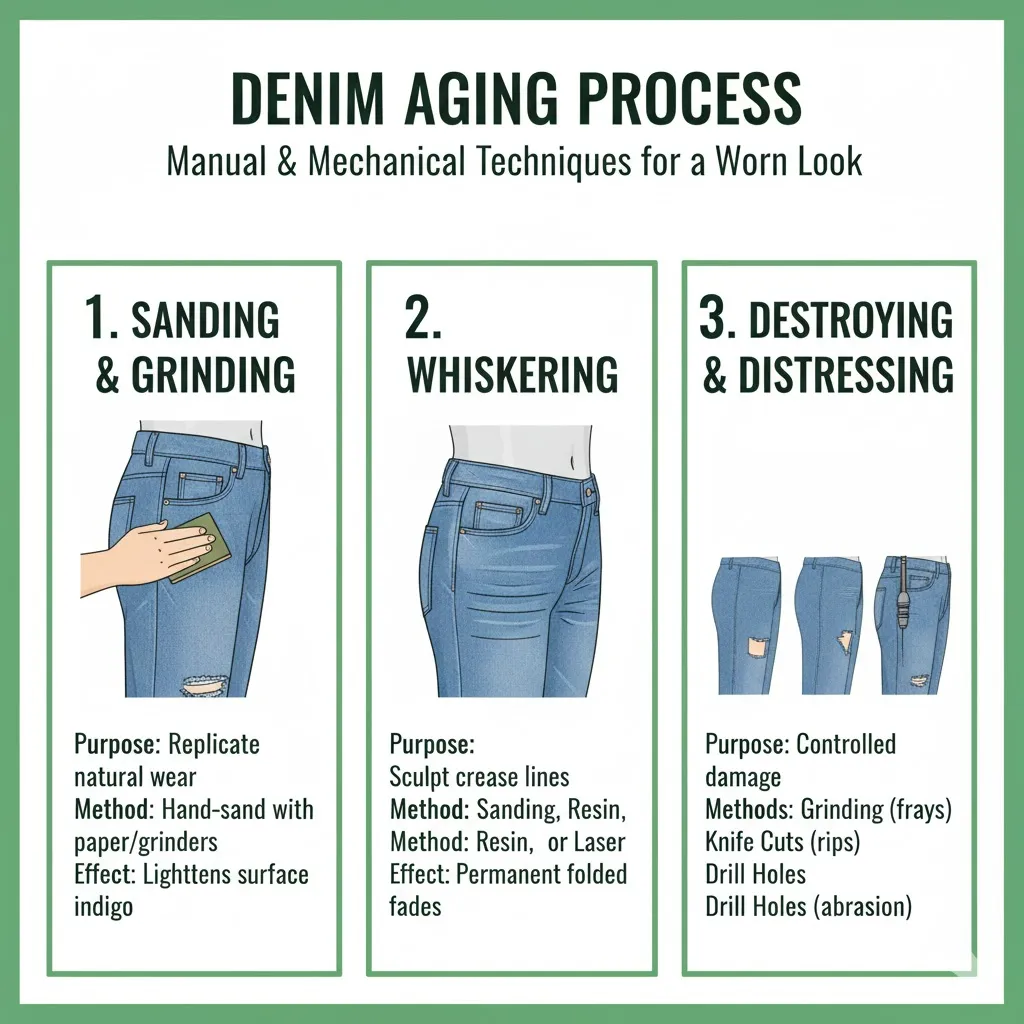 Denim Distressing Process
Step 1: Sanding & Grinding — The First Layer of Aging
Operators manually sand areas where natural friction occurs during wear: thighs, knees, and seat. This is done with abrasive paper blocks or handheld grinders.
Purpose: Replicates real-life usage patterns.
Effect: Lightens surface indigo to create the foundation fade.
Real Case (European Menswear Label, 2023):
A client requested a subtle worn-in look suitable for premium office denim. Our technicians performed low-intensity sanding using 400-grit paper with a controlled pressure technique. The final garment retained a clean appearance while offering visual depth around high-contact zones, increasing perceived fabric value without appearing distressed.
Step 2: Whiskering — Sculpting the Crease Lines
Whiskers (also called moustaches) are the horizontal crease lines formed around the lap area. To achieve realistic whiskers, the garment is placed over a shaped template or mannequin, and either sanded by hand or treated with resin to set permanent folded lines.
Purpose: Simulates creases formed naturally by body movement.
Process: Either manual sanding, resin application, or laser engraving.
Industry Insight (Based on Denim Finishing Benchmark Report 2023):
Brands increasingly favor laser whiskering for its precision and sustainability. Mechanical whiskering remains dominant for heritage and artisanal collections that seek natural texture.
Step 3: Destroying & Distressing — Controlled Damage with Purpose
This process involves carefully cutting, grinding, or tearing fabric to achieve frays and holes that look naturally aged rather than artificially produced.
Techniques include:
Grinding: To create frayed patches.
Knife cuts: For clean rips.
Drill holes: To mimic long-term abrasion.
Factory Field Record (Fabric-Supplier, 2024):
During a distressing project for a North American streetwear client, we observed that using a dual-layer reinforcement (placing a cotton voile beneath targeted tear areas) increased tear resistance of ripped jeans by 27% while maintaining the visual effect. This improved product longevity without altering aesthetics—a key selling point for the brand’s “premium destruction” concept.
Media Reference (Sourcing Journal, 2022):
“Distressed denim with reinforced interiors is now the standard for mid-to-high-end brands, as consumers demand both aesthetic authenticity and durability.”